Background, but brief
What is a PIP?
A Public Interest Payphone is a coinless telephone, funded by Maine ratepayers, that lets you make free local and emergency calls in places where a phone is a safety matter. It is a vending machine for help.
Some of these phones are “smart.” They answer maintenance calls with a modem squeal and report their own health. This is a phone that can tell you about itself. The 1980s would like it back, but it has become a public utility, so it stays.
How the modem fits in
Weekly remote checks
PTS Providers is the equipment provider for Maine’s PIPs. A host computer calls each phone weekly; a smart board answers and reports its health. A failed host call generates a service ticket.
This is a system in which a computer calls a payphone, the payphone answers in modem, and everyone involved considers this a normal Tuesday.
The cause, allegedly
The phones were held hostage by an invoice
Consolidated (now Fidium): “fully disconnected”
On Sept. 3, a Consolidated Communications phone representative said the PTS account was “fully deactivated”; the commercial department said “fully disconnected.” Two departments, two words, same bad news.
PTS: “a billing dispute”
A PTS representative said by email the cause was an unpaid bill, noting that “state accounts are often 60 days late.” Which is corporate for: the state was 60 days late, and somebody at the phone company finally said “no.”
The email was addressed to someone else. Secondhand billing gossip, in other words. We will not be quoting it at a dinner party.
Consolidated/Fidium serves most sites; FirstLight serves Newry, home of the Step Falls phone. This is why Step Falls kept working: it is on the other phone company, and it did not get the memo about the bill.
The plot thickens
Dialing 0 on an emergency phone connects you to a Medicare call center
At Augusta and Cumberland, dialing 0 (or a specific number) put the caller into a hold loop that, after about 76 seconds, delivered them into an automated Medicare-adjacent marketing operation. Recordings exist, and unlike the payphones, they are publicly available: pip_augusta.m4a (3:47, transcript) and pip_cumberland.m4a (3:26, transcript). We have listened to them. We regret to report they are as advertised.
“Thank you for calling.” — the payphone, which you did not call, because you are standing at it
The pitch, in order:
- An offer to “press 1 to speak with a licensed insurance agent” about Medicare plans.
- A disclosure: “by remaining on the line, you may receive additional offers unrelated to Medicare plans.” Translation: hang up. It says the quiet part out loud and you should leave.
- A free medical-alert-device offer, pitched to a caller who is literally using a public safety phone.
- A voice identifying herself as “Hi, this is Jessica, on a recorded line.” Jessica is a recording. Jessica cannot help you. Jessica is the problem.
- A question about whether the caller is over 50. The phone itself is from the 1980s. Everyone on this call is over 50.
- At Augusta the call ended shortly after the “50” exchange. The system hung up before the caller could. Rude, but efficient.
Important note: this only happens if you dial 0 or a specific number. Ordinary calls behave like ordinary calls. You have to go looking for the Medicare pit to fall into it, which is somehow both comforting and alarming.
The resolution
Most of the phones came back
A Sept. 4 fleet scan showed 9 of the 10 formerly modem-answering lines completing again: Jay PD, Kittery PD, Lamoine, Madawaska, Greenville, Machiasport, Augusta/Lithgow Library, Cumberland/Prince Memorial Library and Glenburn Town Office, plus Step Falls, which never left. The phones have now been through the full arc of a TV drama: collapse, mystery, corporate villain, redemption arc, roll credits.
Jay Police Department is back. Jay’s phone went from “outbound calls blocked, call 911” to completing again in a week, which is faster than most customer service tickets.
Footage of the Augusta/Lithgow Library phone, from Sept. 1: PIP Lithgow Public Library, Augusta (12.9 MB). It is exactly as exciting as a payphone being alive should be.
Reading of the results
The restoration is selective: the two long-busy-to-NLIS lines stayed down, the chronically dead sites stayed dead, and Freeport stayed converted. The phones that got better are the ones that were restricted, not the ones that were broken. It turns out a payphone with an unpaid bill recovers quickly once someone pays it.
“Completed” means a call completed, not that a human answered. The automated sweep cannot tell a person from a modem squeal. Philosophically, neither can we.
The town-office canvass
Three failure types, three little stories
Berwick Town Hall
207-698-1291
Present but never worked. Confirmed by the town and by 63/63 failed calls over 10 months. The phone’s only job was to exist, and it performed that job flawlessly.
St. Agatha Town Office
207-543-5096
Physically removed when the old building was demolished. The phone did not survive the building. The building is fine. The phone is gone. Nobody filed the paperwork, which is a separate crime against paperwork.
Glenburn Town Office
207-942-4579
Chronically flaky all year, died in the same August window as everyone else. Whether it was part of the batch or just its own thing remains unclear. Some phones are just like that. We have all worked with a Glenburn.
Another field baseline
Rumford was already asking for money it cannot take
Rumford Information Booth · 207-364-2071
Before the late-August drama, the Rumford phone near the Paul Bunyan statue was already running its own small drama. Local calls did not complete: the phone requested a 35-cent deposit, and the instrument has no coin slot. It is a coinless phone asking for coins. Either a firmware bug or performance art, and the evidence cannot tell them apart.
Toll-free calls did work, which is the phone being selective rather than generous. After dialing, the keypad and DTMF tones appeared to disable themselves, so calling cards and anything that needed more digits were out. The phone accepted the call and then stopped taking input, which is a mood.
Incoming behavior
Rumford would accept incoming calls, but the physical phone had no audible ringer, so a caller would hear roughly five rings before the line gave up. The phone did not care. The phone never cares.
Pre-change classification: partially functional. In payphone terms, that is a glowing review.
Not dead, just different
Freeport found its purpose
Freeport Public Safety Building · 207-865-3069
The Freeport PIP is physically present. Its signage now identifies it as a TTY telephone, and it auto-dials dispatch the moment the handset is picked up. It does not wait for you to dial. It knows what you need. It is the hero of its own story.
This is why the weekly modem check stopped getting answers: the phone no longer answers as a programmable payphone. It is busy being a direct line to dispatch, which is arguably a better use of a phone than answering modem calls from a computer that wants to know how it is feeling.
Photos
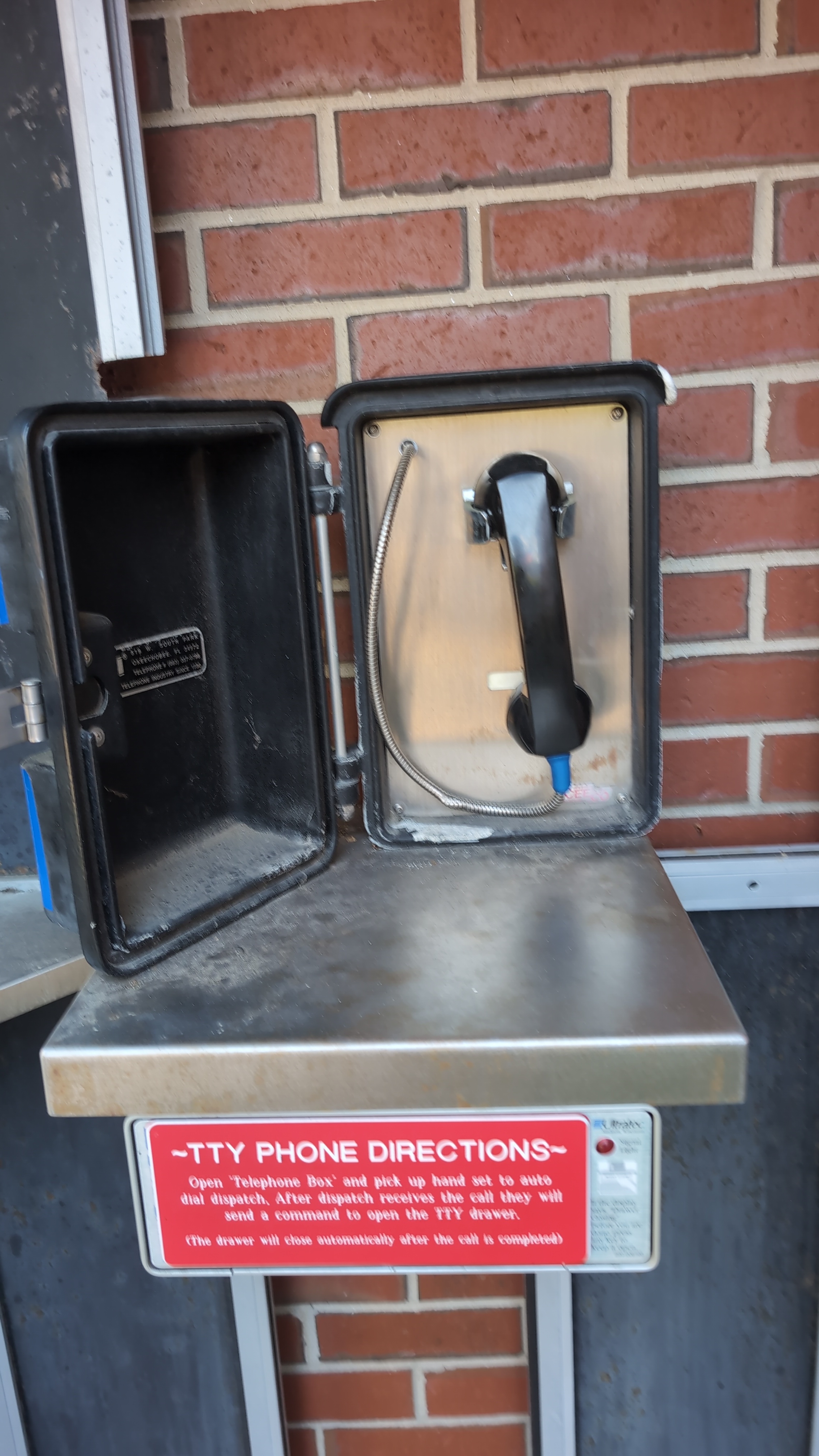
A payphone that went to trade school.
Field audio methodology
The recording rig, lovingly over-engineered
Recorder and levels
Field audio is captured with a Zoom H5 at WAV 48 kHz/24-bit. Lossy compression distorts pure tones, which matters when your evidence is mostly dial tone and hold music.
Peaks are set around -18 dBFS, the input knob is taped so it can’t drift, the induction coil is marked to the same handset position every time, and every session opens with 30 seconds of untouched dial tone as a calibration reference.
This is an extraordinary amount of rigor for recording a phone say “please wait one moment” for 76 seconds. It is also exactly the right amount. If you are going to investigate a payphone, investigate it properly.
The PM-1 preamp
The pickup runs through a PM-1 piezo preamp: JFET, input impedance over 10 MΩ, output about 600 Ω, about 20 dB of gain, powered by its own rechargeable battery so it doesn’t touch the recorder’s phantom power.
Early recordings without it were noticeably low. With it, the Medicare pitch is loud and clear. We now have pristine audio of a payphone pitching a free medical alert device. This is the most Maine sentence ever recorded.
Session discipline
Each dial string is spoken aloud before dialing, a mark is dropped at that moment, and the date and time are set before leaving. The file timestamps are treated as part of the record, because the only thing better than catching a payphone doing something weird is catching it doing something weird on a correctly-set clock.
Monitoring database
The database is optimistic
26 numbered PIPs plus one canary number live in the monitoring database. Known issues:
- The failures counter is stuck at 0 for every row. Either it is a bug, or this is the most optimistic database in Maine.
- Two confirmed-nonexistent Raymond sites are still flagged as counting toward totals. The database believes in them. The database has faith.
- Great Cranberry Island Post Office is tagged ACTIVE while showing NO-ANSWER. Even the database cannot decide.
The canary number exists to detect bad conditions, like a canary. It also does not answer. Nobody talks about the canary. The canary is the quietest part of this investigation, and we are choosing to respect that.
What is known and unknown
The moral
Supported by the observations
A fleet of state-funded emergency payphones stopped answering, then mostly started again, because of an unpaid bill and a restriction that was later lifted. The phones are, for now, fine.
Also supported by the observations
Dialing 0 on some of these phones routes you into a Medicare-adjacent call center. A public safety phone should probably not do that, and yet here we are, with recordings.
●This is a comedy version of a real investigation. The facts are real; the jokes are ours. The serious version lives at error48.com/pip/, and it does not make jokes about Jessica, because Jessica is a recording and the serious version respects the evidence.
If you are over 50 and still reading, please remain on the line for additional offers unrelated to this page.