Update · Sept. 3-4, 2026
Reported cause, then a partial restoration
Consolidated: “fully deactivated”
On Sept. 3, a Consolidated Communications (now Fidium) phone representative said the PTS account was “fully deactivated”; escalated within the same call, the commercial department said it was “fully disconnected.”
PTS: a billing dispute, “straightened out”
A PTS representative said by email the cause was an unpaid bill by PTS to Consolidated/Fidium (“state accounts are often 60 days late”), that Consolidated “restricted the lines,” and that it “was straightened out yesterday within 24 hours... everything should be back to normal.”
That email was addressed to someone else, likely a journalist at the Sun Journal, not this reporter, so it needs independent confirmation before being quoted as an answer to his own inquiry.
Consolidated Communications (now Fidium) serves most PIP sites; FirstLight serves one, Newry, home of the Step Falls phone. That is why the “working” control kept completing while the Consolidated-served lines were restricted.
Fresh scan · Sept. 4, 2026
Most Consolidated-served lines are completing again
A fleet-wide scan ran on the morning of Sept. 4 (last_tested timestamps 08:24-08:25 UTC) — the first full sweep since the Aug. 27 collapse. Ten numbers returned COMPLETED, including nine that had stopped completing after Aug. 16-23.
Restored: Jay PD, Kittery PD, Lamoine, Madawaska, Greenville, Machiasport, Augusta/Lithgow Library, Cumberland/Prince Memorial Library, Glenburn Town Office, plus Step Falls (the never-down control).
Still down: Berwick Town Hall (never worked), St. Agatha (removed in April). Springvale and South Berwick are busy again (field-observed Sept. 4). Both Raymond sites are physically removed (town-verified Sept. 4). Freeport Public Safety Building did not come back as a modem line — but the phone is physically present and appears to have been repurposed rather than failed (see below).
Reading of the results
The restoration is selective: 9 of the 10 formerly modem-answering lines are completing again, while the two long-busy-to-NLIS lines and the chronically dead sites did not come back. Freeport stopped completing in July for a different reason: it was converted to a TTY telephone that auto-dials dispatch (see below), not a failure of the August type.
“Completed” means the call completed in the automated sweep, not that a person answered. The metric matches the pre-collapse baseline, so it is directly comparable, but field checks are still needed to confirm the phones work as PIPs, not just that they answer.
Town-office canvass
Three distinct failure types beyond the August event
Berwick Town Hall
207-698-1291
Present but never worked. Confirmed by both the town and 63/63 failed Twilio calls across 10 months. Chronic, unrelated to August.
St. Agatha Town Office
207-543-5096
Physically removed around April 2026 when the old building was demolished; independently confirmed by the Twilio log (last answer Apr. 12, dead from Apr. 19). Likely undocumented under the 30-day removal-notice statute, 35-A M.R.S. §7508(1).
Glenburn Town Office
207-942-4579
Chronically flaky all year, died in the same Aug. 16-23 window as the main event. Ambiguous whether part of that batch or coincidental.
Town-office calls are a new low-cost verification method: they confirm physical presence or absence without a site visit.
Monitoring database
Full roster obtained, with data caveats
The reporter’s own monitoring database lists 26 numbered PIPs plus one canary number. The Sept. 4 morning scan updated all rows (last_tested 08:24-08:25 UTC), the first fleet-wide sweep since Aug. 27; results are summarized in the fresh-scan section above.
Known data-quality issues in that system:
- A failures counter stuck at 0 for every row regardless of actual history.
- include_in_counts flag had been set true for both Raymond locations; the town manager confirmed Sept. 4 that both phones are physically removed, so they are excluded from the call list and any published uptime statistic.
- One internally inconsistent row: Great Cranberry Island Post Office tagged ACTIVE but showing NO-ANSWER, unlike the other ACTIVE-tagged lines.
Any published uptime statistic should be treated as unreliable until these are fixed.
Reconciling prior reporting
Earlier findings still open
Published coverage
Sun Journal: “Maine’s Public Interest Payphones Remain a Critical Safety Link,” Dec. 4, 2025 (updated Dec. 26, 2025).
A related but not identical Rumford defect: keypad locking during a calling-card test, versus the currently documented unpayable 35-cent/$1 coin demand on a coinless instrument.
Unverified December 2025 outages
Six PIPs already reported out of service as of Dec. 2025, not yet re-verified as still gone: Hosmer Field/Rumford, Searsmont General Store, Sidney’s, Stetson Town Office, Stockton Springs, Winn General Store.
Newry/Step Falls, the current “working” control phone, showed an “Error 48” fault and screeching modem tone on inbound as of Nov. 2025, not yet reconciled with its current clean state.
Open / pending
What happens next
Recovery timeline
The Sept. 4 scan was diffed against the Aug. 27 baseline: 9 of 10 formerly modem-answering lines are completing again. Next steps are field checks to confirm restored phones actually work as PIPs.
Fourteen untested sites
14 of the 26 sites have never been individually tested by phone or in person, only by the weekly robocall.
Background
What is a PIP?
Maine’s Public Interest Payphone program is administered by the Maine Public Utilities Commission. The Commission describes a PIP as a coinless public telephone that allows free local and emergency calls, with card or operator assistance available for long-distance calling.
The phones are intended for locations where telephone access serves public health, safety and welfare needs. The program is funded by Maine telephone ratepayers.
Many of these phones are not conventional coin payphones. Some use programmable “smart” electronics that can answer maintenance calls and report information about the phone.
How the modem fits in
Weekly remote checks
PTS Providers is a national public communications company that installs, maintains, repairs and remotely monitors payphones and coinless public phones. PTS is the equipment provider responsible for Maine's PIP installations and service.
In a May 2026 email, a PTS installer explained that a host computer calls PIP phones once a week. When a smart board answers, it can report call counts and whether the phone appears healthy. A failed host call can generate a service ticket.
The installer also said incoming calls are generally not intended for public use and that smart boards can be programmed either way. That means loss of the audible modem response does not, by itself, prove a PIP is dead.
The late-August shift
A statewide pattern, not one local failure
Numbers that previously produced repeatable completed/modem responses.
Step Falls Preserve, 207-824-2386, still completed repeatedly Aug. 27.
Springvale and South Berwick changed from persistent busy to audible no-longer-in-service treatment.
Jay, Kittery, Lamoine and Madawaska still produce their established completed-call behavior. Several of these patterns had been stable for months.
Jay, Kittery, Lamoine and Madawaska no longer complete. Greenville and Machiasport still do. Springvale and South Berwick are still busy.
Greenville and Machiasport have also stopped completing. Augusta and Cumberland no longer produce their former modem response. Springvale and South Berwick now play NLIS intercepts. Step Falls continues to answer.
Statewide status table
Previous behavior and the latest change
Aug. 27 baseline table — 37 sites
| Location | Number | Previous behavior | Latest change / current evidence | Verification |
|---|---|---|---|---|
| Stockton Springs Cape Docks | 207-567-3627 | NLIS | No known new change | Historical NLIS |
| Lamoine Consolidated School | 207-667-3487 | Active modem; highly consistent completions | Stopped completing after Aug. 16 | Field check needed |
| Bangor Department of Health & Welfare | 207-942-1580 | No prior monitoring baseline | Modem answer on manual test | Field-verified Sept. 4 |
| Madawaska Fire Station #2 | 207-728-6182 | Active modem | Stopped completing after Aug. 16 | Field check needed |
| Mt. Vernon Fire Station #2 | 207-293-2405 | Previously rings / no answer; had stopped completing much earlier | NLIS recording | Audibly confirmed Aug. 28 |
| Searsmont Fraternity Village Gen. Store | 207-342-2709 | NLIS | No known new change | Historical NLIS |
| Springvale Nasson Community Center | 207-324-0396 | Busy for months | Busy again (was NLIS Aug. 23-27) | Field-observed Sept. 4 |
| Dover-Foxcroft Police Department | 207-564-2348 | No prior monitoring baseline | Rings, then goes busy | Field-observed Sept. 4 |
| Greenville Police Department | 207-695-0260 | Active modem | Completed Aug. 23; no longer completing Aug. 27 | Field check needed |
| Jay Police Department | 207-897-3253 | Active modem; stable through Aug. 16 | Stopped completing Aug. 16-27 with outbound restriction field-verified Aug. 27; completing again Sept. 4 | Field verified Aug. 27; scan restored Sept. 4 |
| Kittery Police Department | 207-439-4312 | Active modem | Stopped completing after Aug. 16 | Field check needed |
| Cliff Island Post Office | 207-766-2159 | No prior monitoring baseline | Rings | Audibly confirmed Aug. 28 |
| Great Cranberry Island Post Office | 207-244-7128 | Rings / no answer | Rings / no known new change | Recheck |
| Freeport Public Safety Building | 207-865-3069 | Active modem | Stopped completing after July 26; physically present, converted to TTY that auto-dials dispatch on pickup | Field verified; see photos |
| Sidney Recreational Ball Field | 207-547-2235 | NLIS | No known new change | Historical NLIS |
| Sandy Point Beach | 207-567-3619 | NLIS | No known new change | Historical NLIS |
| Little Cranberry Island Town Dock | 207-244-7095 | No prior monitoring baseline | Rings | Audibly confirmed Aug. 28 |
| Berwick Town Hall Building | 207-698-1291 | Previously rings / no answer | NLIS recording | Audibly confirmed Aug. 28 |
| South Berwick Town Hall Building | 207-384-0928 | Busy for months | Busy again (was NLIS Aug. 23-27) | Field-observed Sept. 4 |
| Glenburn Town Office | 207-942-4579 | Rings, but intermittently completed; completed Aug. 16 | No longer completing Aug. 23-27; completing again Sept. 4 | Scan restored Sept. 4; field check needed |
| Machiasport Town Office | 207-255-4042 | Active modem | Last completion Aug. 23, only 1 sec; no longer completing Aug. 27 | Field check needed |
| Raymond Town Office | 207-655-1080 | Rings / no answer | Physically removed; confirmed absent by the town manager | Town-verified Sept. 4 |
| Sidney Town Office | 207-547-2236 | NLIS | No known new change | Historical NLIS |
| St. Agatha Town Office | 207-543-5096 | Previously rings / no answer; last completion in April | Physically removed ~April (building demolished); NLIS recording is the carrier intercept | Removal documented; intercept audible Aug. 28 |
| Stetson Town Office | 207-296-2528 | NLIS | No known new change | Historical NLIS |
| Winn General Store | 207-736-2136 | NLIS | No known new change | Historical NLIS |
| Fryeburg Rescue Building | 207-935-1578 | Previously rings / no answer | NLIS recording | Audibly confirmed Aug. 28 |
| Rumford Information Booth | 207-364-2071 | Partially functional: local calls requested 35¢ despite no coin slot; toll-free worked; inbound could be answered with no audible ringer | Current post-change field state not yet established | Priority field recheck |
| Palmeter's Store, Meddybemps | 207-454-7527 | Previously rings / no answer | NLIS recording | Audibly confirmed Aug. 28 |
| Raymond Snack Shack | 207-655-1193 | Rings, but intermittently completed; completed Aug. 16 | Physically removed; confirmed absent by the town manager | Town-verified Sept. 4 |
| Biddeford Central Office | 207-282-6593 | Previously rings / no answer | NLIS recording | Audibly confirmed Aug. 28 |
| Jackman Health Center | 207-668-9249 | No prior monitoring baseline | Modem answer on manual test | Field-verified Sept. 4 |
| Step Falls Preserve | 207-824-2386 | Active modem | Still completing repeatedly Aug. 27 | Control; field check recommended |
| Bangor Public Library | 207-995-0145 | No prior monitoring baseline | Rings | Audibly confirmed Aug. 28 |
| Lithgow Public Library, Augusta | 207-626-0631 | Active modem; MPUC page still showed pending installation | Stopped completing after Aug. 16 | Field check needed |
| Prince Memorial Library, Cumberland | 207-829-3127 | Active modem; newer installation not shown on supplied MPUC list | Stopped completing after Aug. 16 | Field check needed |
Previous behavior combines repeated call-log observations and field notes. “No longer completing” means the historical modem-like answer disappeared from the monitored call path. It does not by itself establish that the physical PIP is out of service. Field-verified conditions are labeled separately.
Aug. 28 spot checks established first baselines for six previously unmonitored MPUC-listed numbers: Dover-Foxcroft and Jackman return NLIS recordings; Cliff Island, Little Cranberry Island Town Dock and Bangor Public Library ring. A Sept. 4 manual test of Bangor Health & Welfare (207-942-1580) and Jackman Health Center (207-668-9249) each produced a modem answer; a call to Dover-Foxcroft Police Department (207-564-2348) rang, then went busy.
Former modem-answering group
What the latest call logs show
| Location | Number | Last known completion | Latest logged behavior |
|---|---|---|---|
| Step Falls Preserve, Newry | 207-824-2386 | Sept. 4 | still completing |
| Jay Police Department | 207-897-3253 | Sept. 4 | completing again |
| Kittery Police Department | 207-439-4312 | Sept. 4 | completing again |
| Lamoine Consolidated School | 207-667-3487 | Sept. 4 | completing again |
| Madawaska Fire Station #2 | 207-728-6182 | Sept. 4 | completing again |
| Greenville Police Department | 207-695-0260 | Sept. 4 | completing again |
| Machiasport Town Office | 207-255-4042 | Sept. 4 | completing again |
| Lithgow Public Library, Augusta | 207-626-0631 | Sept. 4 | completing again |
| Prince Memorial Library, Cumberland | 207-829-3127 | Sept. 4 | completing again |
| Freeport Public Safety Building | 207-865-3069 | July 26 | no longer completing as a modem; converted to TTY auto-dial dispatch |
Status as of the Sept. 4, 2026 fleet scan. “Completed” describes call-log behavior and the previously observed modem-like answer; it does not necessarily mean a person answered the telephone. The Aug. 16-27 collapse and the recovery timeline are covered above.
Field verification
Jay was restricted, then restored
Jay Police Department · 207-897-3253
Aug. 27 field check: a physical check after the call-log change found a live dial tone, but an ordinary outbound telephone call produced a recording stating that outbound calls were not allowed and directing emergency callers to hang up and call 911. A call to 1-800-444-4444, a toll-free ANI readback number recommended by a PTS installer as a useful PIP test, also did not work.
Dialing 0 reached an operator-service path identifying itself as Fidium, formerly Consolidated Communications, but no operator answered: a looping “please wait one moment” recording repeated on an 8.42-second cycle. The reporter hung up before any further transfer.
Current state: Jay is back in the Sept. 4 fleet scan as completing again (COMPLETED). The Aug. 27 outbound restriction appears to have been lifted along with the other Consolidated-served lines, but no fresh field check has confirmed ordinary calling works again yet.
Why that matters
The Aug. 27 Jay result was different from merely disabling incoming modem access. The physical line remained connected enough to provide dial tone, collect digits, play restriction treatment and reach an operator-service path, while ordinary outbound calling was restricted.
The MPUC’s public description of a PIP says the phones allow free local and emergency calls. Chapter 252 also establishes calling requirements for PIPs, including direct-dialed local, n11 and toll-free calling.
●That field observation established that the restriction applied to ordinary outbound calling, not just inbound modem access. It did not establish why the line changed. The Sept. 4 scan now shows the restriction lifted at the network level; a field re-check is needed to confirm the phone itself is back to ordinary PIP functionality.
Operator and directory paths · field audio
Public-emergency lines route into a Medicare call center
The recordings
Field audio from two sites documents a hold loop that transfers into an automated Medicare-adjacent marketing operation.
- Augusta: pip_augusta.m4a · transcript
- Cumberland: pip_cumberland.m4a · transcript
Transcripts below are machine-generated (Whisper small model) from the field recordings; telephony audio, so minor word errors are possible. Timestamps are in the recording.
Augusta — pip_augusta.m4a (3:47)
[00:23-00:25] ...making outbound phone calls.
[00:25-00:29] If this is an emergency, please hang up and dial 911.
[00:29-00:32] To be connected to Consolidated Customer Service,
[00:32-00:33] please press one.
[00:33-00:36] To be connected to Consolidated Collection,
[00:36-01:07] please press two.
[01:07-01:19] Please wait one moment.
[01:19-01:27] Please wait one moment.
[01:27-01:38] Please wait one moment.
[01:38-01:47] Please wait one moment.
[01:47-01:58] Please wait one moment.
[01:58-02:07] Please wait one moment.
[02:07-02:23] Please wait one moment.
[02:23-02:26] This call may be recorded for quality assurance.
[02:26-02:29] We have a special promotion today for select callers.
[02:29-02:32] If you are over 50, please press one now.
[02:32-02:34] If not, press pause.
[02:34-02:37] If you are over 50, please press one now.
[02:37-02:44] If not, press pause.
[02:44-02:47] This call may be recorded for quality assurance.
[02:47-02:51] We have a special promotion today for select callers.
[02:51-02:54] If you are over 50, please press one now.
[02:54-02:57] If not, press pause.
[02:57-02:59] Hello and congratulations.
[02:59-03:01] Just for calling today, we're offering you
[03:01-03:03] a free medical alert device.
[03:03-03:05] You know, it's the little life-saving button
[03:05-03:08] you can wear around your neck in case of an emergency.
[03:08-03:11] These devices are often very expensive,
[03:11-03:15] so press one now to take advantage of this special offer.
[03:15-03:16] Hi, thanks for holding.
[03:16-03:18] This is Jessica on a recorded line.
[03:18-03:20] I see you've been selected for a free medical alert
[03:20-03:23] device, so congratulations.
[03:23-03:25] You know it's that little button you depress
[03:25-03:26] in case you have a bad fall.
[03:26-03:28] I just need to verify a few quick details
[03:28-03:36] so we can get your free device sent out OK.
[03:36-03:37] Sorry I didn't hear you.
[03:37-03:43] Can you repeat that?
[03:43-03:46] Sorry I didn't hear you repeat that.
Cumberland — pip_cumberland.m4a (3:26)
[02:10-02:14] ...a special promotion today for select callers.
[02:14-02:17] You are currently enrolled in Medicare Part A and Part B
[02:17-02:20] and want to review your Medicare Advantage plan options,
[02:20-02:22] which may include additional plan benefits
[02:22-02:25] and check your eligibility for the enrollment period,
[02:25-02:27] please press one now.
[02:27-02:30] If you have Medicare Part A and Part B
[02:30-02:31] for your health insurance,
[02:31-02:34] or if you are new to Medicare, aging in, losing coverage,
[02:34-02:37] or on Medicare, but have recently moved
[02:37-02:39] and are interested in learning about the plan options,
[02:39-02:42] which may include additional plan benefits,
[02:42-02:45] press one now to speak with health care solutions
[02:45-02:48] and confirm coverage to review Medicare Advantage plans
[02:48-02:50] that may be available in your area
[02:50-02:52] or remain on the line for additional offers
[02:52-02:54] unrelated to Medicare plans.
[02:54-02:58] Again, press one now to speak to a licensed insurance agent
[02:58-03:01] who can check your eligibility for enrollment
[03:01-03:03] or please remain on the line for additional offers
[03:03-03:11] unrelated to Medicare plans.
[03:11-03:13] Congratulations.
[03:13-03:16] You've been selected for a special promotion today
[03:16-03:20] to receive a free medical alert device.
[03:20-03:22] You know, the life-saving button
[03:22-03:26] that gets you help instantly during an emergency.
[03:26-03:26] The... (recording ends)
How the path is reached
Dialing 0 at Jay produced no operator: a looping “please wait one moment” recording repeated on an 8.42-second cycle. At Augusta, dialing a specific ten-digit number reached the same hold on an 8.44-second cycle; a sliding audio comparison matched the two recordings at 0.584-0.659. Cumberland’s version scored lower (0.37-0.50): suggestive, but not confirmed as the identical recording.
The transfer
At Augusta, the hold ran about 76 seconds and then handed the caller into the marketing system. Cumberland’s recording picks up inside the same marketing pitch, so it reached the transfer as well. At Jay the reporter hung up during the hold — Jay never reached the marketing routing.
The pitch
As transcribed from the Augusta and Cumberland recordings:
- An inbound-style greeting, “thank you for calling,” despite this being a call the payphone was routed into rather than one the caller dialed, then an offer to “press 1 to speak with a licensed insurance agent” about Medicare-related plans.
- A consent-laundering disclosure: “by remaining on the line, you may receive additional offers unrelated to Medicare plans.” That line exists to justify treating everyone who stays on hold as having consented to being pitched things beyond insurance, which is what happens next.
- A free medical-alert-device offer.
- A voice identifying herself as “Hi, this is Jessica, on a recorded line,” asking qualifying questions, including whether the caller is over 50, the standard age gate for Medicare-adjacent sales.
- A repeated “wait one moment” hold, recurring roughly eight times through this stretch, consistent with an operation queuing callers between an automated front end and available live agents.
- At Augusta the call ended shortly after the “50” exchange, then returned to dial tone.
What is confirmed, and what is not
Augusta and Cumberland both reached the marketing pitch — it was transcribed from both recordings. Jay never did: the reporter hung up during the hold at Jay, so nothing past the hold is confirmed there. Cumberland’s hold recording is a weaker match to Jay’s than Augusta’s.
This entire path starts from dialing 0 or a specific ten-digit number, not from any ordinary call. It is a legitimate and reportable finding about where a public emergency phone’s operator path actually leads, but it does not mean an ordinary caller dialing a normal number would encounter it.
Field audio methodology
Recording setup
Recorder and levels
Field audio is captured with a Zoom H5 Handy Recorder, recording WAV at 48 kHz/24-bit — not MP3 and not 96 kHz. Lossy compression distorts pure tones and DTMF, and 24-bit gives enough headroom that the gain never needs to be adjusted mid-session, which matters because absolute level comparisons across recordings depend on the gain staying fixed.
Peaks are set around -18 dBFS at the start of each site visit and the input knob is taped or marked so it can’t drift. The induction pickup coil is marked to the same position on the handset every time. Every session opens with 30 seconds of untouched dial tone at that same gain, which serves as an internal calibration reference and lets any two recordings be compared against each other rather than only against themselves.
The line pickup runs through a PM-1 piezo pickup preamplifier into Input 1 via a 3.5mm-to-1/4" adapter; the recorder’s own XY capsule stays active on L/R as a room mic, capturing the spoken slate, ambient conversation, and anything audible at the earpiece acoustically.
The PM-1 is a small JFET, high-input-impedance charge-type preamp intended for piezo/contact microphones. It buffers the very high-impedance piezo signal and raises it to a stronger, lower-impedance output the recorder can handle more effectively: input impedance greater than 10 MΩ, output impedance about 600 Ω, gain about 20 dB, with 1/4-inch TS mono in and out. It runs on its own rechargeable battery, so it does not draw phantom or plug-in power from the recorder. The chain is piezo/contact pickup → PM-1 preamp → Zoom H5. That is a better match than feeding the pickup straight into a recorder input, because a piezo loaded by too-low an input impedance sounds weak and loses low-frequency energy. Early induction/contact recordings without the PM-1 were noticeably low-level; with it, the signal is more usable and the impedance match is correct.
Setup photo
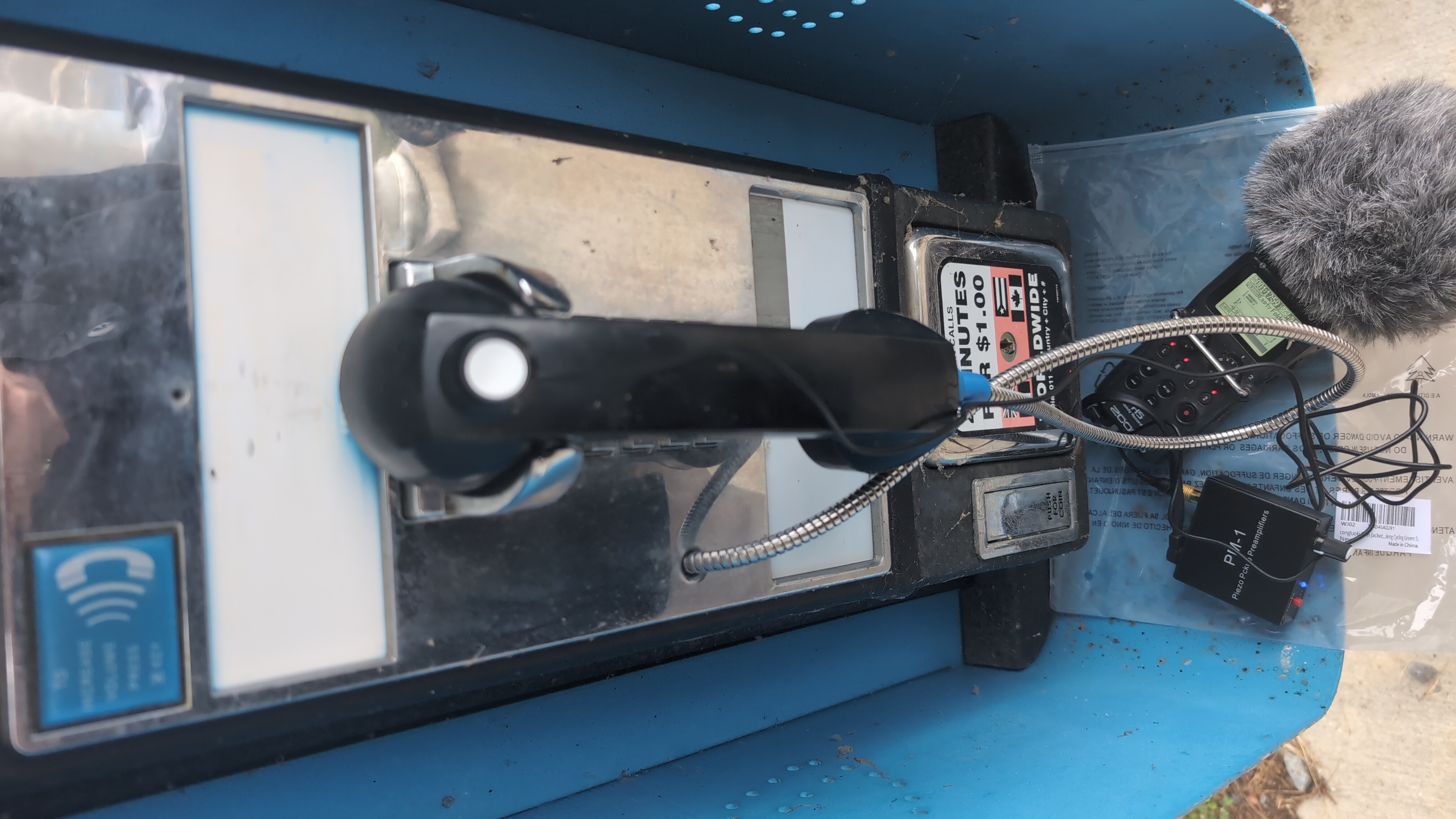
The rig as used in the field. Click for full size.
Track layout and safety
The unit records in 4-channel multi-file mode so the coil and room mic land as separate WAVs, with Backup Record on for L/R as a free safety net at -12 dB.
- Phantom power, plug-in power and the input pad are off — the coil is a passive pickup and doesn’t want 48V or attenuation.
- Lo Cut is on at its highest setting to strip 60Hz mains hum picked up from nearby wiring, which sits well below the phone band.
- Limiter and compressor are off — nonlinear gain corrupts the envelope cross-correlation the audio analysis depends on.
- Auto Rec is off — it gates on input level and would discard genuine silence, which turned out to be data in itself: the several seconds of true quiet before certain calls connect.
- Pre-Rec is on as a two-second buffer against clipped starts.
Session discipline
Each dial string is spoken aloud onto the recording immediately before it’s dialed, and a mark is dropped at that moment, either by pausing on REC or via PLAY/PAUSE, both of which get tested at the start of a session before being relied on in the field. The date and time are set correctly before leaving, since the file timestamps are treated as part of the record.
Another field baseline
Rumford was already only partially functional
Rumford Information Booth · 207-364-2071
Before the late-August change, the Rumford PIP at Veterans Park, near the information center and Paul Bunyan statue, was already operating in a limited state rather than as a normal full-service PIP.
Local calls did not complete. The phone requested a 35-cent deposit, but the instrument has no coin slot, making those calls impossible to finish.
Toll-free calls did work. After dialing, however, the keypad and DTMF tones appeared to become disabled, limiting the usefulness of calling cards or other services that require additional digit entry.
Incoming behavior
The Rumford line could receive incoming calls, but the physical phone had no audible ringer. An incoming call would continue for roughly five rings before ending if the handset was not picked up.
Pre-change classification: partially functional.
This makes Rumford a useful comparison case because its limitations were directly observed before the broader late-August changes. It should not be grouped with phones that simply returned “No Answer” without a field inspection.
Another field baseline
Freeport: not gone, converted
Freeport Public Safety Building · 207-865-3069
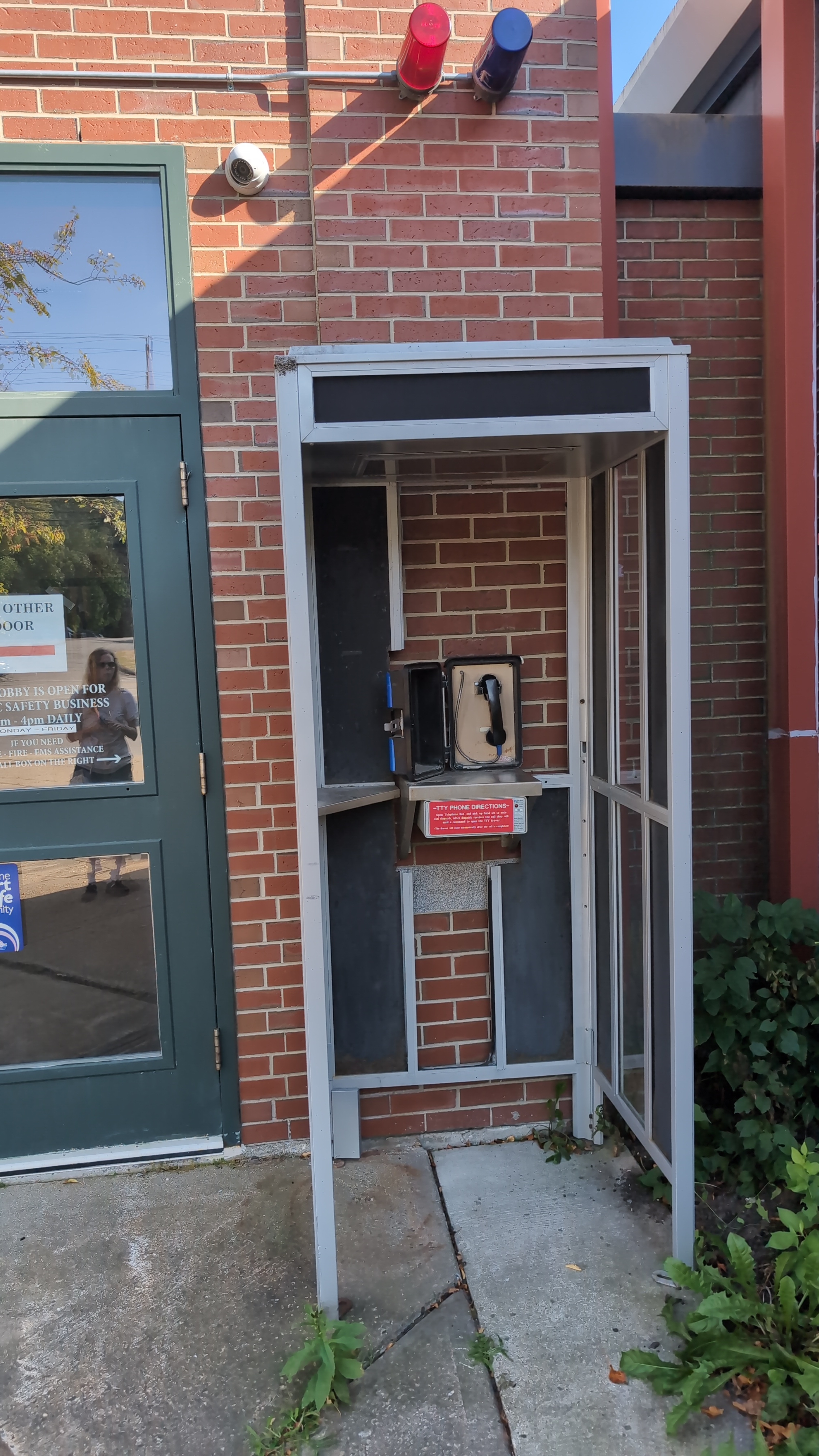
The Freeport PIP is physically present, unlike the two Raymond sites (confirmed physically removed by the town manager, Sept. 4) or St. Agatha’s. What changed is its function: the signage at the phone now identifies it as a TTY telephone, and it auto-dials dispatch the moment the handset is picked up, rather than functioning as an ordinary payphone a caller dials out from.
That was confirmed by testing: picking up the handset connects directly to dispatch. This explains why the weekly monitor stopped seeing a modem answer after July 26 — the line no longer answers as a programmable payphone, so the host call gets no modem response even though the phone is in service for its repurposed role.
Unlike the late-August restriction on the Consolidated-served lines, Freeport’s change happened earlier (July) and is a reconfiguration of the instrument itself, not a carrier-side block.
Photos
Field photos of the Freeport phone:
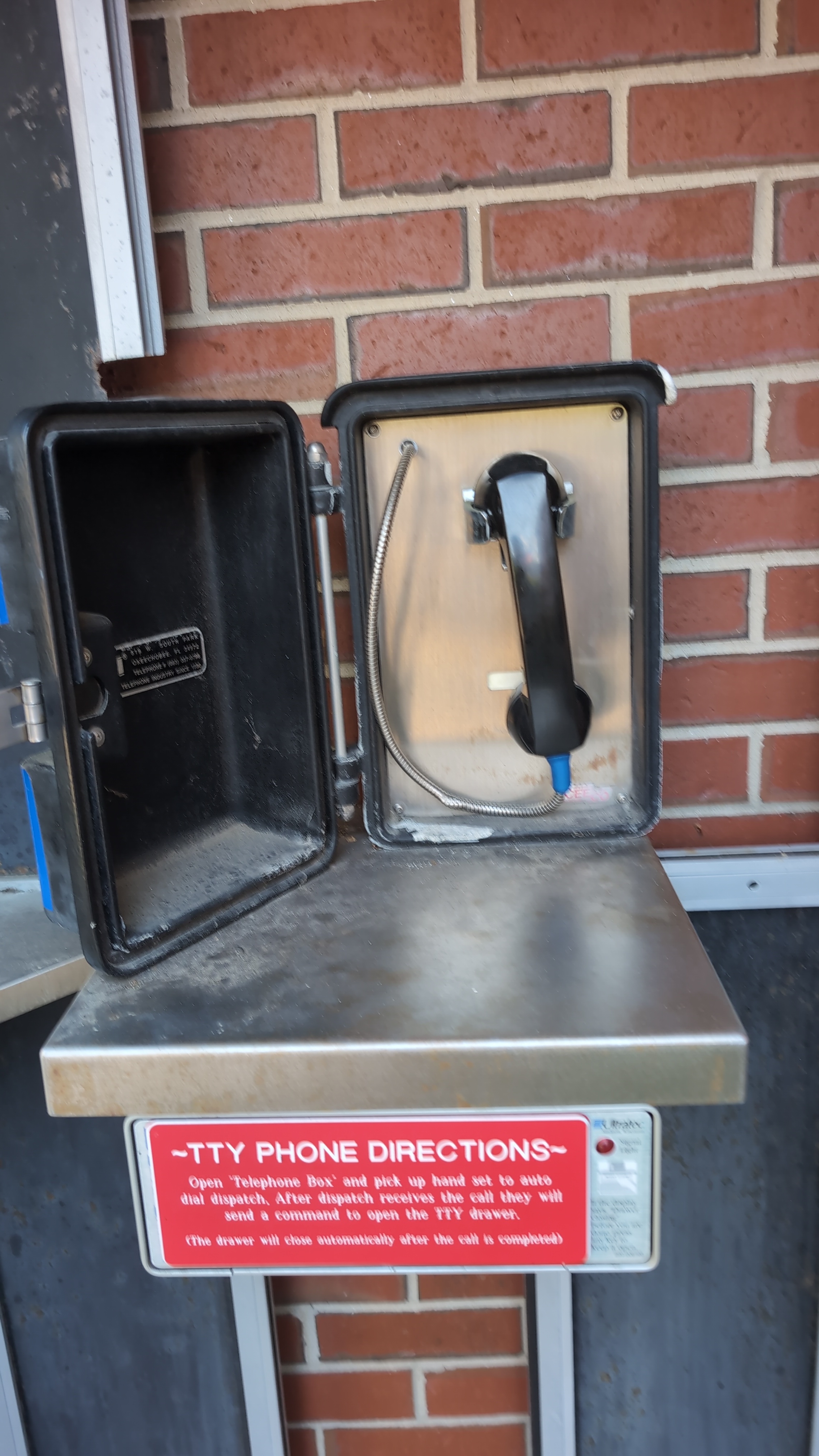
Click for full size (3.2 MB). freeport1.jpg is the second photo.
A useful control
Step Falls is the exception
Step Falls Preserve in Newry, 207-824-2386, was the only number in the previously identified 10-phone ACTIVE MODEM group that kept completing through the late-August collapse; the Sept. 4 fleet scan shows the other nine completing again too.
The Step Falls line is served by FirstLight rather than Consolidated (now Fidium), and it remained the working control throughout. A field check can test the same ordinary local call, the same 1-800-444-4444 ANI readback number, operator access through 0, and the phone’s response to incoming calls.
With Jay also completing again in the Sept. 4 scan, the remaining question is whether the restored lines behave as ordinary PIPs in the field, not just at the network level. Step Falls remains the comparison case: a field check can test the same ordinary local call, ANI readback, operator access and inbound response across both.
Photo
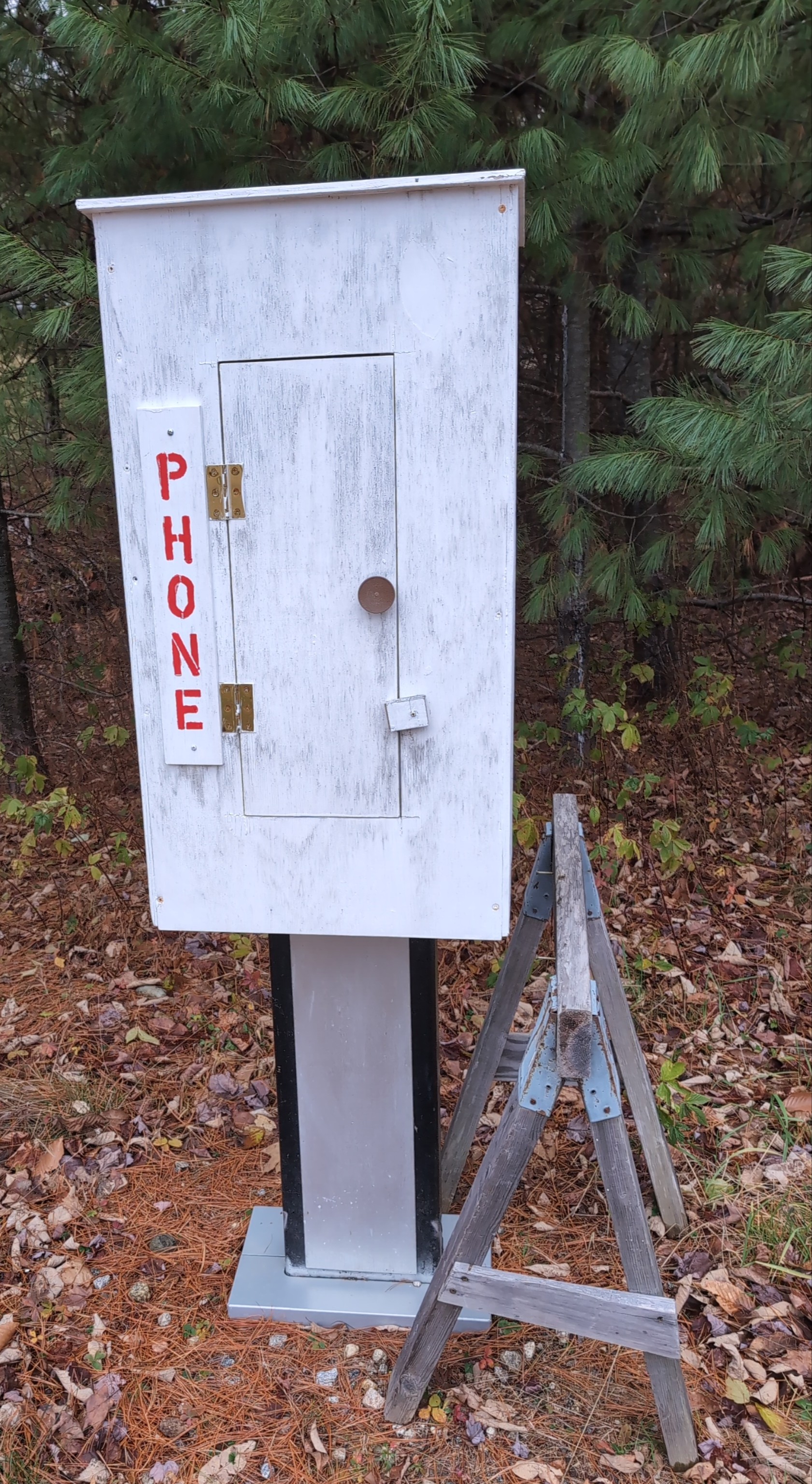
The Step Falls PIP as of early September. Click for full size.
What is known and unknown
The working interpretation
Supported by the observations
Multiple geographically separated PIP numbers changed within a narrow late-August window. The change is not confined to one exchange or one part of Maine.
Almost every number that had been consistently answering with a modem-like response stopped doing so. Two long-term busy lines changed to NLIS. An Aug. 27 field check at Jay showed the physical instrument still connected but ordinary outbound calling restricted; the Sept. 4 scan shows that restriction lifted at the network level.
Not established yet
The call logs alone cannot show whether the modem-answering PIPs are physically out of service. PTS has indicated that incoming calling can be disabled by programming, so a deliberate smart-board configuration change remains a plausible explanation for some of the lost modem responses.
It is also not yet known whether a coordinated maintenance campaign occurred, or whether PTS’s own weekly host is still successfully polling the phones.
Next checks
Remaining checks
Field audio
Completed at four sites (Jay, Augusta, Cumberland, Newry) in early September. Recordings document the restriction announcement, the looping operator hold, and the Medicare-adjacent pitch reached through the operator path.
ANI readback
Use 1-800-444-4444 on working PIPs to verify toll-free calling and record the originating number presented by the line.
Trace the call center
Identify the operator behind the Medicare/medical-alert pitch that the operator path transfers into, and whether routing emergency-adjacent payphone lines into it is intentional or a misconfiguration.
Sources and project links